
The Global Cancer Burden: Where Does Lung Cancer Stand?
Lung cancer is a significant public health issue, ranking as the second most frequently diagnosed cancer and the primary cause of cancer-related deaths worldwide. In 2020, there were an estimated 2.2 million new cases and 1.8 million deaths attributed to lung cancer. It remains a critical global burden of disease because of its high incidence rate and considerably poor survival rate. The incidence and mortality of lung cancer vary substantially by geographical regions and sex, with a particularly high burden in Asia and male individuals.1
Understanding Lung Cancer?
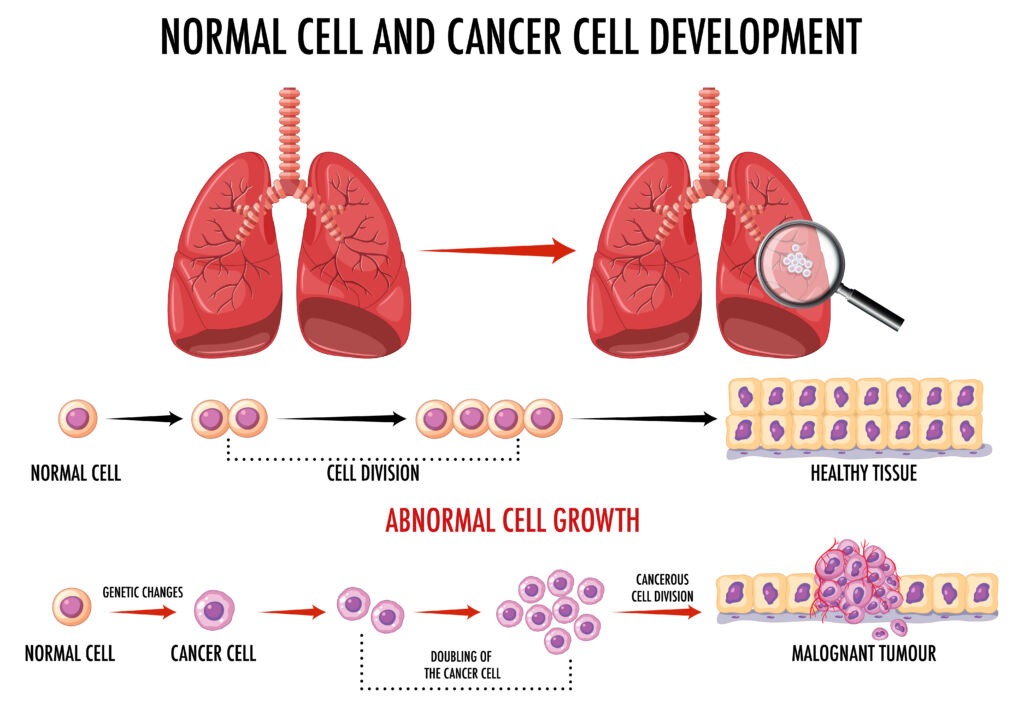
Lung cancer is one of the most common malignant cancers in most countries and is the leading cause of death among cancer diseases worldwide. Despite constant progress in diagnosis and therapy, survival rates of patients diagnosed with lung cancer remain unsatisfactory2
Common types of lung cancer?
Lung cancer begins in the airways of the lungs. These include the bronchi (the tubes leading to the lungs), the bronchioles (tiny branches of air tubes in the lungs), and the alveoli (the tiny air sacs at the end of the bronchioles).
Types of lung cancer are named after the cells found in the cancer. Doctors use special tests to determine what type of cells led to cancer. Because the cells grow and spread differently, knowing the type helps doctors choose ways to treat the cancer. The most common lung cancer types are:
- Adenocarcinoma, which begins in cells that line the alveoli and make mucus.
- Squamous cell carcinoma, which begins in the thin, flat cells that line the inside of the lungs.
- Small cell carcinoma, which begins in neuroendocrine cells that line the inner airways of the lungs.
As targeted lung cancer treatment has improved over the years, tests are more frequently used to figure out the lung cancer type, and fewer cancers are of an unknown type.1 Also, the use of filtered cigarettes, and changes in tobacco blends used in cigarettes, have affected which part of the lung and what type of cells the lung cancer commonly starts growing in.3
Key Risk Factors for Lung Cancer?

1. Tobacco smoking
Cigarette smoking is the largest single cause of lung cancer, and is responsible for up to 90% of lung cancers in men and 65% in women. Over 60 known cancer-causing chemicals (carcinogens) are found in cigarette smoke. [4]
2. Second hand smoke exposure:
Health problems caused by second hand smoke in adults who do not smoke include coronary heart disease, stroke, and lung cancer, as well as adverse reproductive health effects in women, including low birth weight. [5]
3. Genetic predisposition
Numerous studies have provided evidence that the genetic makeup of an individual is associated with lung cancer susceptibility. The familial aggregation (or occurrence) of lung cancer may be caused by shared environmental exposures, an inherited susceptibility or a combination of both. Familial lung cancer represents a good model for investigating the association between environmental and genetic factors, as well as for identifying the susceptibility genes of lung cancer. [7]
4. Air pollution
Air pollution occurs due to the accumulation of many hazardous substances. All contaminants in the atmosphere, whether gases, particulate matter (PM), or biological particles, are considered sources of air pollution. These dangerous substances may be produced due to production processes, modernisation efforts, or organic phenomena. Air pollution can be classified into physical, gas, chemical, and biological. [6]
Common Signs and Symptoms of Lung Cancer [8]
Most lung cancers do not cause symptoms until they have spread outside the lungs. Some common signs and symptoms of lung cancer include:
- A cough that does not go away or gets worse
- Coughing up blood or rust-colored spit or phlegm
- Chest pain that is often worse with deep breathing, coughing, or laughing
- Hoarse voice
- Loss of appetite
- Losing weight without trying
- Wheezing or shortness of breath
- Feeling tired or weak
- Infections such as bronchitis and pneumonia that don’t go away or keep coming back
References
- Jialin Zhou et al .,Cancer Epidemiology, Volume 93, 2024,102693, ISSN 1877-7821
- Smolarz, B.; Łukasiewicz, H.; Samulak, D.; Piekarska, E.; Kołaciński, R.; Romanowicz, H. Lung Cancer—Epidemiology, Pathogenesis,. J. Mol. Sci.2025, 26, 2049. https://doi.org/10.3390/ijms26052049
- https://www.cdc.gov/united-states-cancer-statistics/publications/lung-cancer-types.html
- Ann Cardiothorac Surg 2014;3(2):221
- https://www.cdc.gov/tobacco/secondhand-smoke/health.html
- Respi. May 2023, Vol. 09 (02); 150-158
- Oncol Lett. 2017 Feb;13(2):535-542. doi: 10.3892/ol.2016.5518. Epub 2016 Dec 20. PMID: 28356926; PMCID: PMC5351216.
- org | 1.800.227.2345